
Optimized Price Discovery (OPD)
Optimized Price Discovery (OPD) adjusts the price reported on winning
bids to improve margin while preserving win rates. LiteSwitch uses
machine-learning models to choose a price-reduction factor for each
winning bid, transforming the inbound price (in_ba, the price after
any applicable client fee) into an optimized outbound price (out_ba)
that is reported onward.
OPD applies machine learning to incoming ad requests and win notifications coming from web pages to adjust bids and make the auction more profitable for the Supplier’s business. Right before responding to a request with a bid, the Supplier calls out to the OPD service to get the optimal price for the impression opportunity and passes that price in the ad response.
General Information
The Supplier runs its internal auction as it normally would when responding to a bid request. Before sending a bid back, it uses OPD to adjust the bid amount and maximize Supplier performance. After receiving a win notification, the Supplier reports it to OPD in a server-to-server (S2S) HTTP call; in response, OPD returns an adjusted clearing price.
Key Terms
Term |
Description |
|---|---|
|
Inbound bid amount – the price after any applicable client fee. |
|
Outbound bid amount – the optimized price OPD returns and the Supplier reports onward. |
|
Per-bid multiplier chosen by the ML model (e.g. 0.55) that maps
|
|
The Supplier’s fixed margin (e.g. 30%) applied before OPD; OPD margin is earned on top of it. |
|
Server-to-server HTTP call the Supplier makes to OPD after a win, used to train the models. |
High-Level Design of SaaS OPD
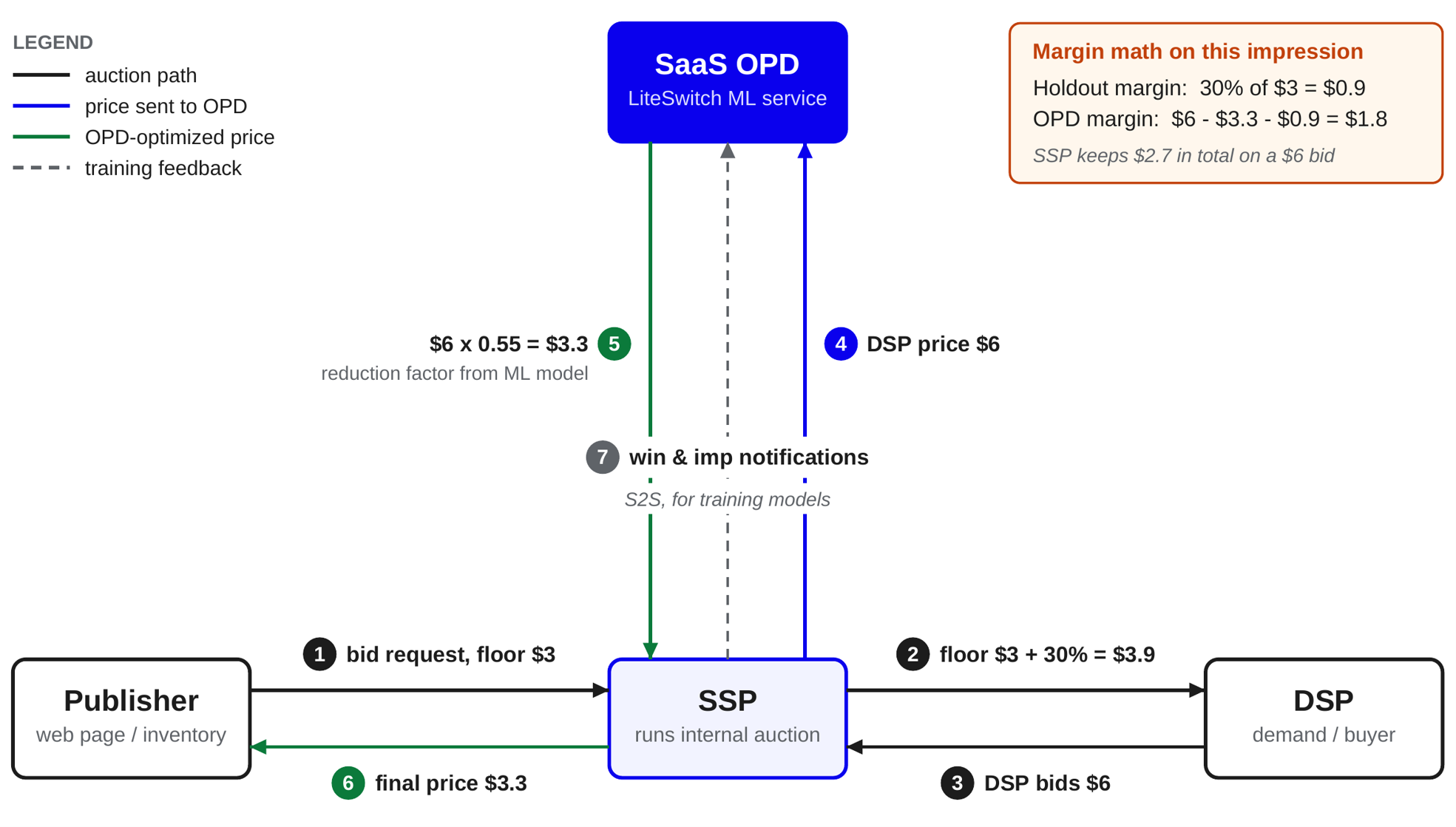
Worked example with a $3 publisher floor, a 30% Supplier holdout margin and a $6 DSP bid. Follow the numbered steps; the solid arrows are the real-time bid path, the dashed arrow is the feedback loop used to train the models.
Publisher sends a bid request to the Supplier with the original floor of $3.
The Supplier adds its 30% holdout margin and forwards a $3.9 floor to the the Buyer.
The Buyer responds with a $6 bid, which wins the Supplier’s internal auction.
Before responding, the Supplier sends the $6 Buyer price to SaaS OPD.
OPD applies the ML-chosen reduction factor (0.55) and returns $3.3.
The Supplier reports $3.3 as the final price to the publisher.
Win and impression notifications flow back to OPD (S2S) to keep the models trained.
OPD Modes
max_margin
Maximize margin without concern for volume (revenue or bid amount).
Use cases
Arbitrage in a multi-Supplier auction – calculates the lowest possible bid to win the downstream header-bidding auction, keeping the entire price difference as profit without adjusting the clearing price.
Margin-constrained Buyers – ideal for Buyer integrations that buy inventory under models where lowering media cost translates directly to client margin or programmatic profit.
optimal
Maximize margin while maintaining volume.
Use cases
Supplier buyer retention – used by mobile Suppliers to offer built-in, low-risk shading to their programmatic buyers, keeping the exchange competitive and attractive to Buyers.
max_wba
Reinvest all extra margin OPD can achieve to maximize volume (win bid amount) while maintaining the same $ margin.
Use cases
Campaign delivery / pacing assurance – heavily used by publishers or Supplier network portfolios with strict delivery guarantees. Shading too much risks losing premium inventory;
max_wbashades just enough to hit cost constraints while keeping win rates high.Budget-constrained PMP deals – when a Buyer has a guaranteed spend target on a private marketplace but wants to shade bids dynamically to stretch budget across more impressions without missing delivery.
limited_margin
Maximize margin up to a ceiling (defined by %); any excess is reinvested to maximize volume.
Use cases
Strict cost-control campaigns – ideal for premium creative formats (outstream, sticky, rich-media video) where the Buyer wants a guaranteed baseline of savings but cannot tolerate aggressive bid drops that could lock them out of premium slots.
Demand Price-Reduction Settings
Balance Modes
Configured for each selected OPD mode.
Mode |
Description |
|---|---|
|
Budget objects per Buyer; balances at the level of the entire Buyer. |
|
Budget objects per Supplier; balances at the level of the entire Supplier. |
|
Budget objects per Buyer-Supplier pair; the most accurate balance for each pair. |
|
Budget objects per client; balances at the level of the entire client. |
|
Works only in |
Price Reporting Modes
Mode |
Description |
|---|---|
|
Do not modify the price; return the same media cost ( |
|
Return the clear price, taking into account redistribution caused by an increase of the initial bid. Overall incoming media cost equals the reported media cost. |
What OPD Skips
OPD does not modify a bid when:
the bid is part of a fixed-price deal;
the inventory is audio content (can be enabled upon request).